In 2008, when we started the Laptop Orchestra of Louisiana (the LOLs), we identified a small but significant problem. If one of the purposes of the LOLs was to engage music undergraduates with no computer experience in the performance of laptop-mediated music, we need a sure-fire way to be sure the computers and software would be up-to-date and turnkey. The challenge was to consistently and reliably launch bleeding-edge software with as little down-time as possible, such that we could create a smooth, seamless performance without long pauses between pieces.
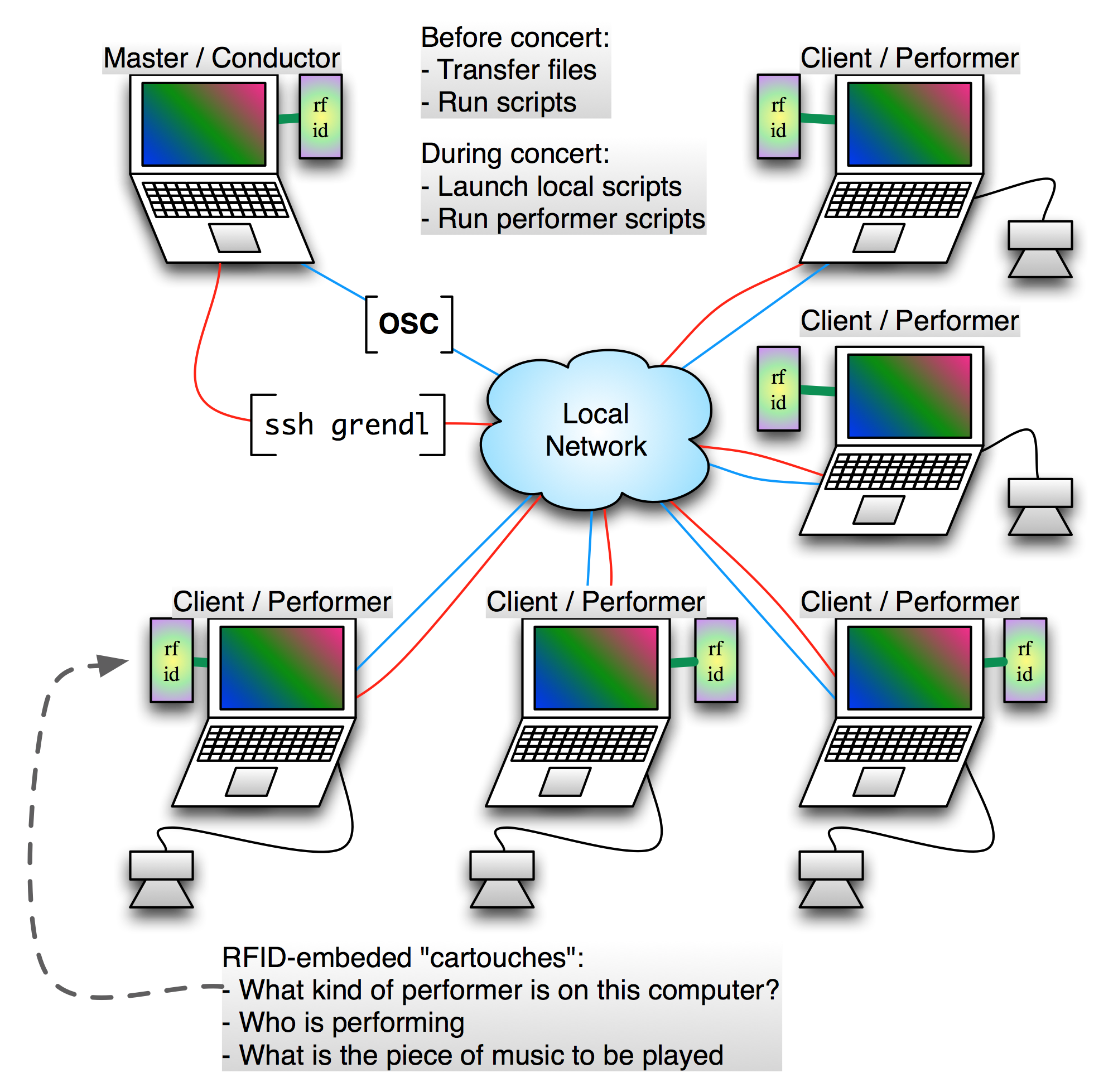
For this, we created GRENDL, or GRid-ENabled Deployment for Laptop orchestras. This software used the computational grid approach for managing loosely coupled computers and applied it to the scale and framework of a local-area network of laptop computers specifically for music. GRENDL had a user-readable markup language to facilitate distribution of software, as well as launch and quit commands that could be remotely run to manage an ad hoc network of computers.
After several years of operation, we increasingly began to employ smartphones and multi-touch tables into our performances and compositions. Unfortunately, GRENDL assumed we worked within a UNIX computer environment, and thus was no longer a viable control solution. The question now became how to control a heterogenous collection of digitally aware objects focused around music making within a local or near-field wired/wireless environment? How do we connect with laptops and mobile devices to each other as well as to other music/audio-centric devices that might exist nearby on TCP/IP (wired or wireless), Bluetooth, or AVB ad hoc networks?
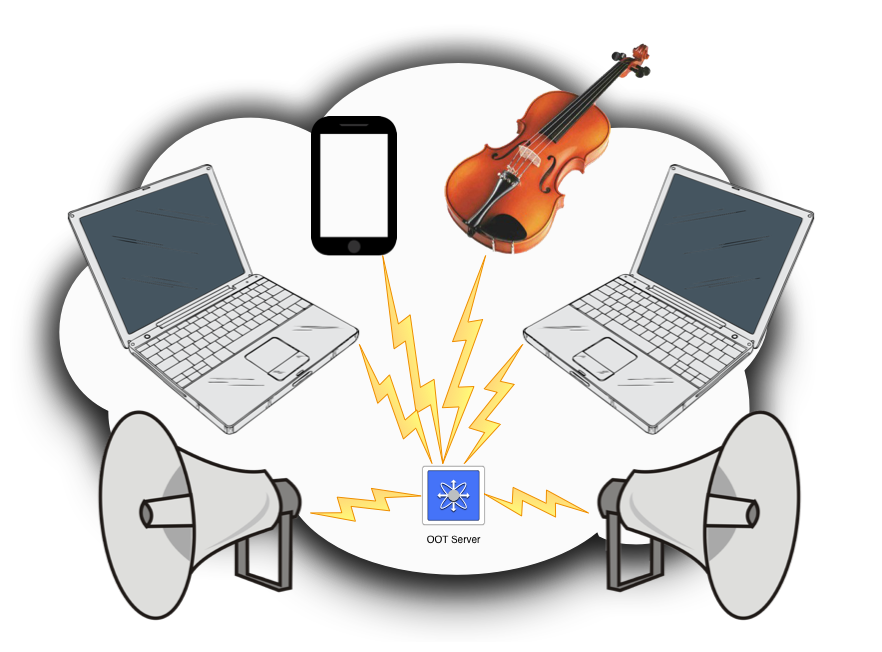 We have turned to the Internet of Things as our inspiration and our metaphor, and created the Orchestra of Things (OoT). In the OoT, all objects (computers, joysticks, phones, speakers) are things. Things can send or receive audio signals. Things can send or receive control signals. Things can be “meta” things, containers of other things that pass messages to and from the outside world. Things can do nothing at all. Things can do any or all or none of these. But they all represent musical objects of one sort or another.
For example, 10 people might have mobile phones with an OoT-enabled app installed. They walk into a room, the OoT server notices that they are nearby and asks them what kind of OoT apps they might have. 8 of the phones respond that they have the “MyOoT App” which is a mobile phone ensemble piece. The OoT server tells the human conductor of this news, and the conductor tells the server to start the apps so that they can be played. The OoT server also provides a time-sync pulse and serves control messages between the apps based on the behavior of other performers.
Or, a conductor might tell the OoT server that s/he wants to perform piece X. The OoT server identifies all of the laptops, mobile phones and tablets, uploads current versions of the X software, and then launches them for a rehearsal.
Much like the Internet of Things, there are a limitless number of applications for the Orchestra of Things. Our primary focus now is for a server to collect and disseminate information about OoT-enabled devices in the immediate area, and to launch/quit applications on those devices for the purpose of performance. A set of milestones will be published shortly as we establish the basic infrastructure.